Coil Topology: Closed Coil
A closed coil is used when the conductor is fully contained within the simulation domain. The conductor forms a continuous loop, and no electrical connections leave the modeled region. This is the typical case for stranded coils, windings, or solid conductors without external terminals.
In this topology, no ports are defined. Instead, you must provide:
- A point inside the coil
- A directional vector that defines the current flow direction
Notes:
- The coil volume must form a closed, electrically connected region.
- The coil faces are not boundary faces.
- The current path is entirely closed inside the domain.
- The magnetic field orientation follows the right-hand rule with respect to the chosen current direction.
- Closed coils are compatible with impressed current, voltage, or circuit-based excitations, depending on the formulation.
Example
A stranded or solid coil fully embedded in the computational domain, with no conductors crossing the outer boundary (Figure 1).
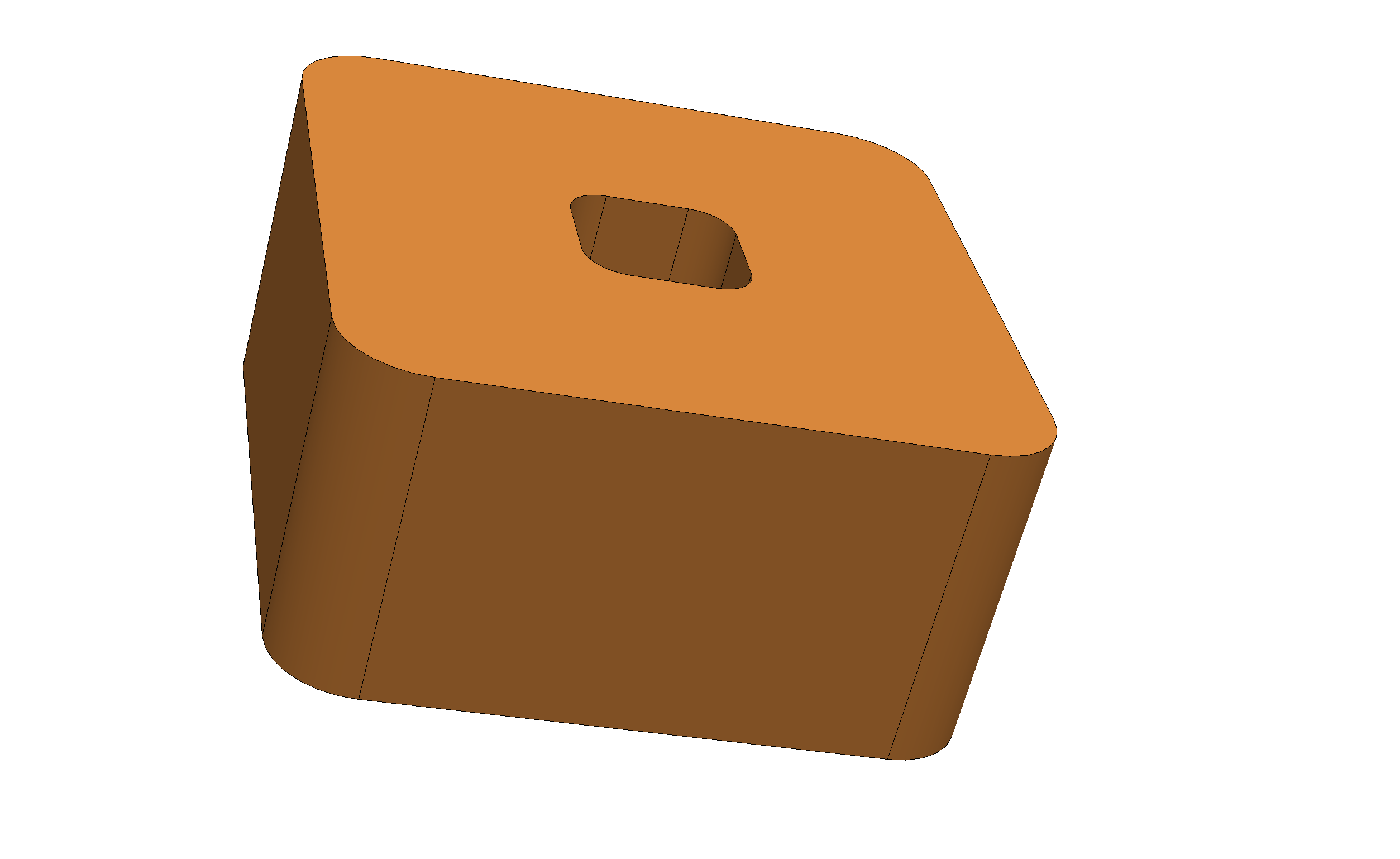
A closed coil topology is defined as follows, where x, y, and z specify a point inside the coil and dx, dy, and dz specify the direction of the current flow: