Coil Type: Solid Coil
A solid coil is a coil made from a single continuous conducting body with no internal insulation or strand structure.
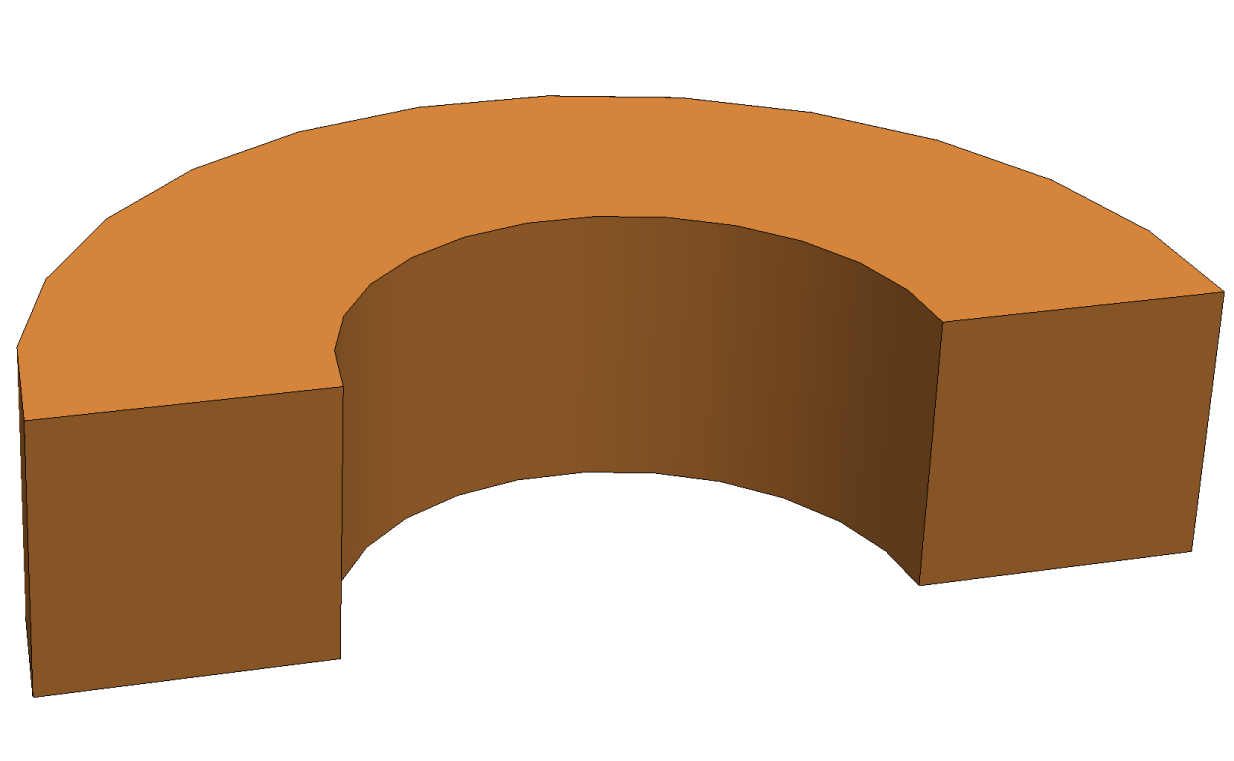
Solid coils typically have only one or a few windings and a large cross-section to carry high electric currents. You commonly use them in induction-heating coils, bus-bars, high-current bars in electrolysis, generator end-windings, and any single-turn / few-turn high-current applications where skin and proximity effects matter.
mufem models the conductor as a fully conductive volume and resolves
eddy currents in it.
Unlike a stranded coil, a solid coil does not homogenize the current
over its cross-section. The current distribution is an unknown field.
The solver finds it as part of the electromagnetic problem.
To disable eddy-current effects, assign a material with
has_eddy_currents=False.
Details
An important phenomenon for solid coils that you drive at high frequencies is the skin-depth effect. The electric currents in the conductor induce eddy currents. These eddy currents force the net current to concentrate near the surface of the conductor.
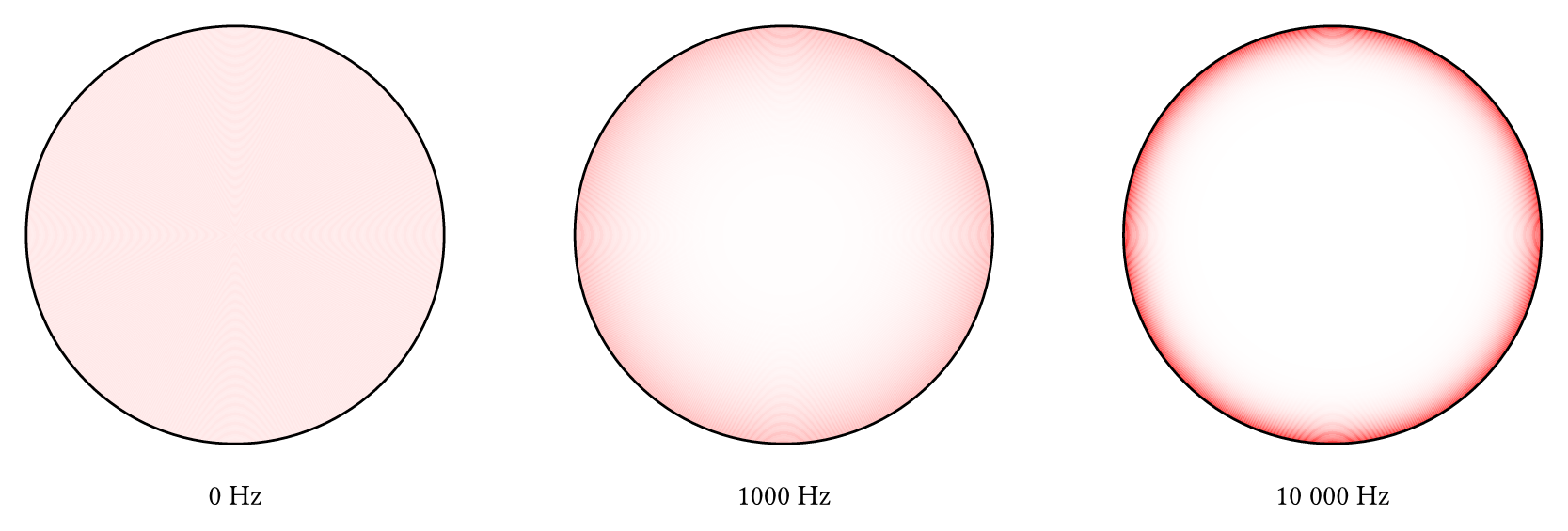
Assume a copper solid conductor with diameter \(d_c = 1\,\mathrm{cm}\) and electrical conductivity \(\sigma = 5.8 \times 10^7\,\mathrm{S/m}\). At a frequency \(f = 1000\,\mathrm{Hz}\), the skin depth is $$ \delta_s = \sqrt{\frac{2}{\omega \mu \sigma}} = \sqrt{\frac{2}{ \left(2\pi \cdot 1000\,\mathrm{Hz}\right) \left(4\pi \cdot 10^{-7}\,\mathrm{H/m}\right) \left(5.8 \times 10^7\,\mathrm{S/m}\right) }} \approx 2.1\,\mathrm{mm}. $$
Since \(\delta_s \lesssim d_c\), a strong current redistribution occurs, with most of the current flowing near the surface.
This reduces the conducting cross-section. So the effective resistance rises and the internal inductance falls.
Nearby conductors can further distort the current distribution through the proximity effect.
Example
A solid coil is created as follows:
Drive method
The solid-coil weak form supports two drive methods (see Sterz 2003):
DriveMethod.Circuit(default) — couples the coil to a circuit equation; the appropriate choice for voltage or current excitation.DriveMethod.Source— treats the coil as a pure current source, skipping the circuit coupling. Useful for prescribed-current benchmarks.