Magnetic Torque Report
mufem calculates the torque with the Maxwell stress tensor \(\overline{\overline{T}}\) [Pa]:
where
- \(\overline{\overline{T}}\) — Maxwell stress tensor [Pa],
- \(\mathbf{B}\) — magnetic flux density [T],
- \(\mathbf{H}\) — magnetic field [A/m].
Here \(\otimes\) denotes the outer (dyadic) product, \(\left( \mathbf{B} \otimes \mathbf{H} \right)_{ij} = B_i H_j\), and \(\overline{\overline{I}}\) is the identity tensor.
To get the torque \(\boldsymbol{\tau}\) [N \(\cdot\) m], integrate over a surface \(S\) that encloses the body of interest:
where \(\mathbf{r}\) is the position vector [m] and \(\mathbf{n}\) the outward unit normal.
In practice mufem evaluates the surface integral as a volume integral of the stress tensor over the layer of mesh elements next to the selected body.
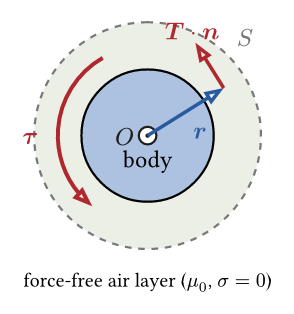
Note
The surrounding region must be force-free. The elements next to the selected body form the layer that mufem integrates the stress tensor over. They must carry no body force: the region must be non-conductive (no eddy currents, so no \(\mathbf{J}\times\mathbf{B}\) force) and have vacuum permeability (\(\mu = \mu_0\), no magnetization force). Surround the body with at least one layer of air/vacuum elements. Do not place the body directly against another magnetic or conductive region, or the reported torque will be wrong.
Usage
from mufem.electromagnetics.timedomainmagnetic import MagneticTorqueReport

rotor_torque_report = MagneticTorqueReport(
    name="Rotor Torque",
    marker="Rotor" @ Vol,
)

rotor_torque = rotor_torque_report.evaluate()
print(f"Rotor torque: {rotor_torque}")
The evaluate() method returns the torque vector about the origin. The
marker selects the body that mufem sums the torque over.
When to use this
- Rotating electric machines — average and ripple torque on a motor / generator rotor; cogging-torque curves vs. rotor angle.
- Stepper and reluctance motors — detent and holding torque characterisation.
- Galvanometers and rotary actuators — torque vs. coil current.
- Magnetic couplings — transmitted torque vs. angular misalignment.
- Halbach-array motors — torque density studies as a function of magnetisation pattern.