Surface Impedance Condition
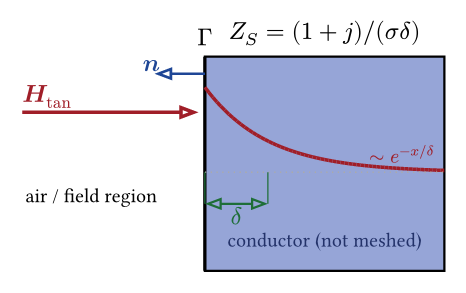
The surface impedance condition (the Leontovich boundary condition) models good-conductor surfaces without resolving the skin depth in the mesh. On a boundary \(\Gamma\) of a high-conductivity region the tangential electric and magnetic fields are linked by
where \(Z_S\) is the surface impedance
with \(\delta\) the skin depth, \(\sigma\) the conductor's electric conductivity, and \(\mu\) its magnetic permeability.
The approximation is valid when the skin depth is small compared to the local feature size (radius of curvature and conductor thickness). Practically: \(\delta \lesssim L / 5\), where \(L\) is the relevant geometric length scale.
Applicability
Applicable on boundary surfaces that bound a good conductor, in the time-harmonic model only. It replaces the conductor interior with an impedance relation and is valid only when the skin depth is small compared with the local feature size (\(\delta \lesssim L/5\)). The conductor is not meshed; its permeability and conductivity are supplied as scalar coefficients on the surface. When the skin depth is comparable to the conductor size, mesh the conductor and resolve the eddy currents instead.
When to use this
- Power transformer and motor tanks. Steel enclosures carry circulating eddy currents at line frequency; the wall is many skin depths thick, so meshing through it is wasteful.
- Induction-heating workpieces. Steel billets, tubes, and pans at the \(\mathrm{kHz}\) range have \(\delta\) in the millimetre range — modelling the surface impedance replaces a dense boundary-layer mesh.
- Bus-bars and shielding cans. Eddy-current loss estimates on thick-walled conductors in the line-frequency to \(\mathrm{kHz}\) range.
- Switchgear and HV equipment. Eddy losses in metallic supports and cladding.
Usage
import numpy
from mufem.electromagnetics.timeharmonicmagnetic import (
    SurfaceImpedanceBoundaryCondition,
)

surface_impedance_bc = SurfaceImpedanceBoundaryCondition(
    name="Surface Impedance",
    marker="Conductor::Surface" @ Bnd,
    magnetic_permeability=4.0e-7 * numpy.pi,
    electric_conductivity=5.0e7,
)

time_harmonic_magnetic_model.add_condition(surface_impedance_bc)
Both magnetic_permeability and electric_conductivity accept scalars or
any scalar coefficient, so you can set spatially varying surface
properties.