Tangential Magnetic Flux Condition
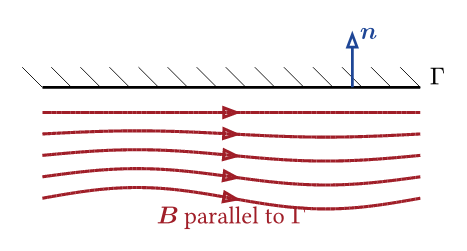
The tangential magnetic flux condition is a boundary condition which enforces the magnetic flux density \(\tilde{\mathbf{B}}\) to be tangential to the boundary by imposing
\[
\mathbf{n} \cdot \tilde{\mathbf{B}} = 0 \quad \text{on} \quad \Gamma.
\]
Equivalently, the tangential component of the magnetic vector potential is pinned, \(\mathbf{n} \times \tilde{\mathbf{A}} = 0\) — a Dirichlet condition. No magnetic flux crosses \(\Gamma\); flux lines run parallel to the surface.
Applicability
Applicable on boundary surfaces. It is an essential (Dirichlet) condition: it pins the tangential vector potential, constraining degrees of freedom directly rather than adding a weak-form term. Use it wherever the flux is known to run parallel to the surface. The condition takes no parameters.
When to use this
- Far-field truncation. On the outer faces of an air box surrounding the device. Make the box large enough for the field to decay. Then a tangential-flux condition is a good approximation of an unbounded domain.
- Symmetry planes. On planes where the magnetic field is parallel to the cut plane (i.e. \(\mathbf{B} \cdot \mathbf{n} = 0\) by symmetry).
- Open-coil ports. The inlet and outlet faces of an open Excitation Coil must carry this condition so the prescribed current is well-defined.
- Idealized superconductors. Surfaces that expel flux (Meissner effect) — useful for first-order screening studies.